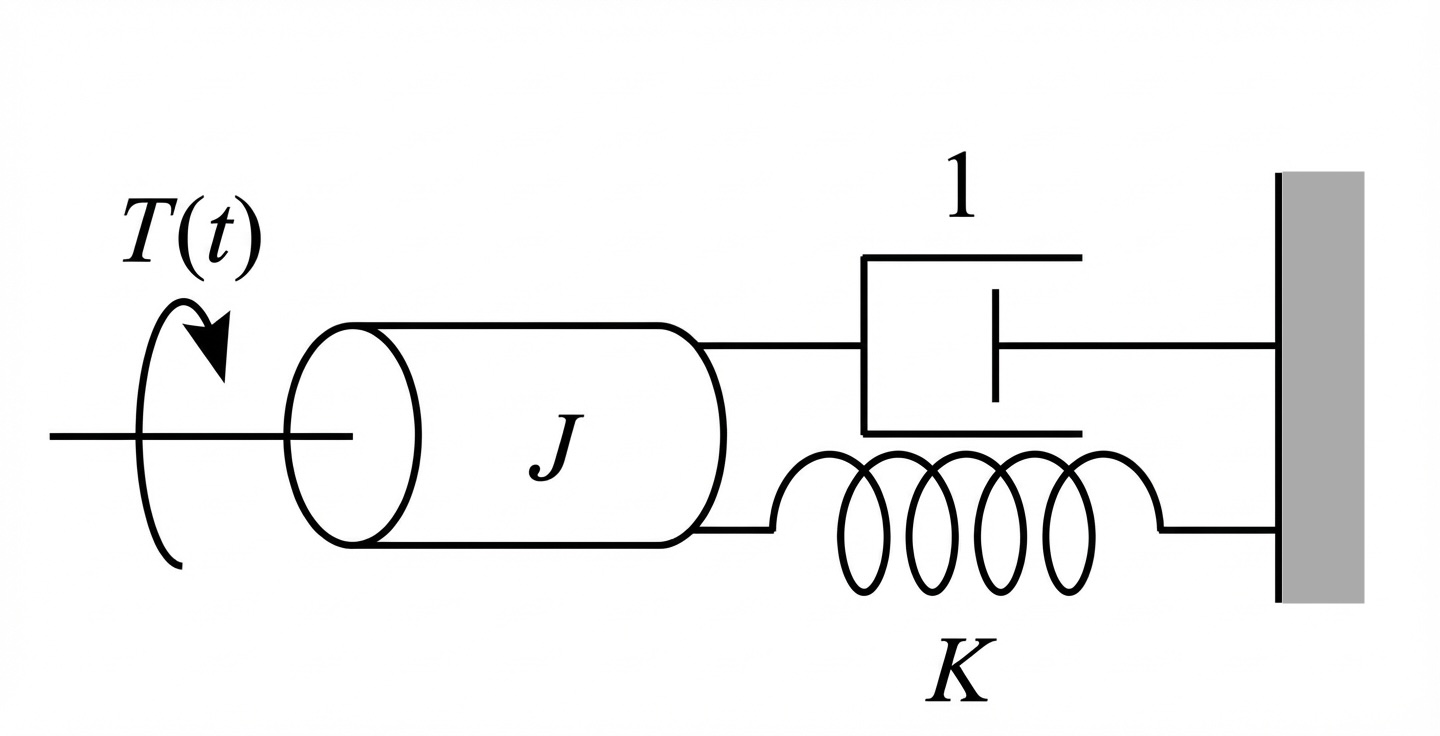
Homework 4
- Due Mar 22, 2026 11:59 P.M.
Problem 1
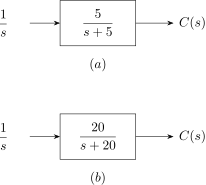
For each of the systems shown below, find (1) , (2) the time constant, (3) rise time, and (4) settling time.
Problem 2
For each of the transfer functions shown below, do the following:
- Plot the poles and zeros on the s-plane (complex plane)
- Write an expression for the form of the transient response,
- State the type of each response (overdamped, underdamped, etc.)
a.
b.
c.
d.
e.
f.
Problem 3
Find the poles of the transfer function
Problem 4
For each transfer function shown below find , , , , , and %.
a.
b.
c.
Problem 5
Find the transfer function of a second-order system that yields a 12.3% overshoot and a settling time of 1 second.
Problem 6
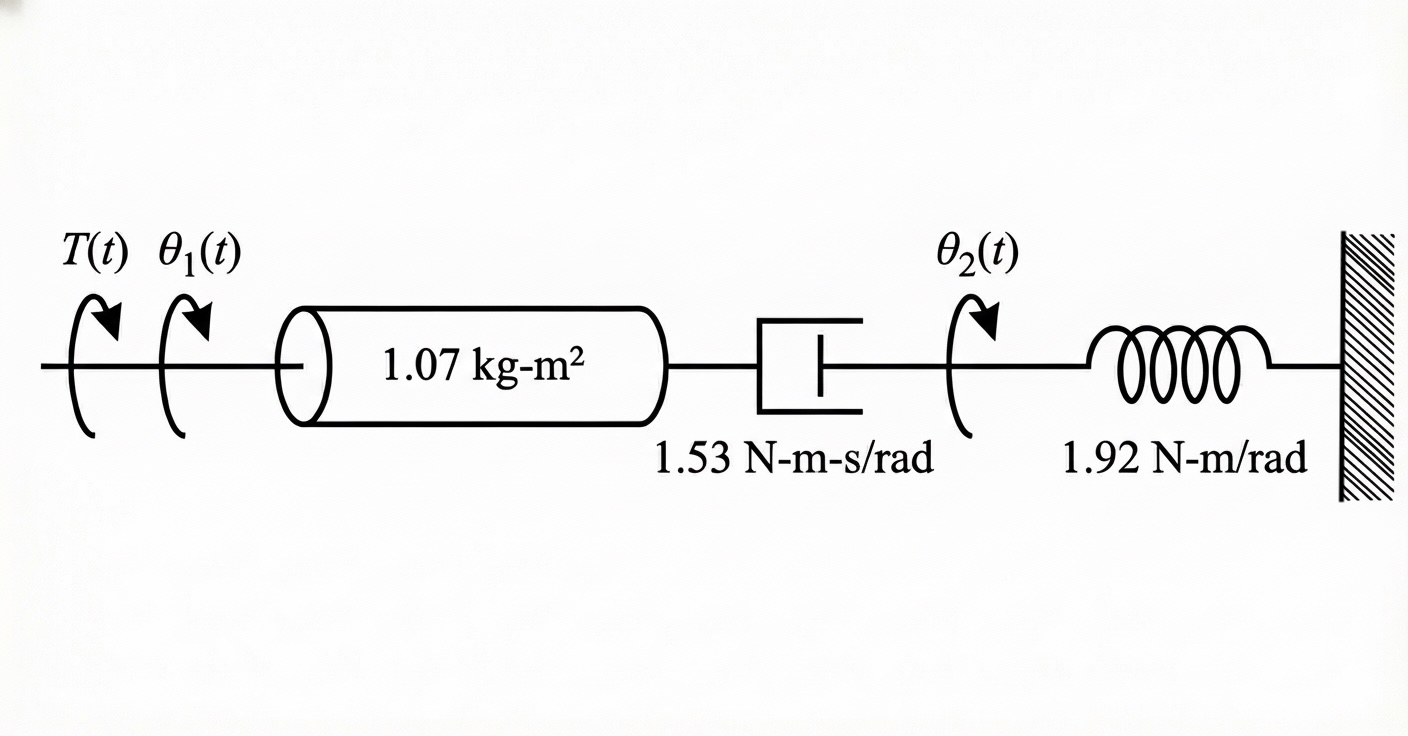
For the system shown below, a step torque is applied at . Find:
A. The transfer function .
B. The percent overshoot, settling time, and peak time for .
Problem 7
Anesthesia induces muscle relaxation (paralysis) and unconsciousness in the patient. Muscle relaxation can be monitored using electromyogram signals from nerves in the hand; unconsciousness can be monitored using the cardiovascular system’s mean arterial pressure. The anesthetic drug is a mixture of isoflurane and atracurium. An approximate model relating muscle relaxation to the percent isoflurane in the mixture is
where is muscle relaxation measured as a fraction of total paralysis (i.e., it has a value between 0 and 1) and is the percent mixture of isoflurane.
A. Find the damping ratio and the natural frequency of the paralysis transient response.
B. Find the maximum possible percent paralysis if a 2% mixture of isoflurane is used.
C. Plot the step response of paralysis if a 1% mixture of isoflurane is used.
D. What percent isoflurane would have to be used for 100% paralysis.
Problem 8
Find and in the rotational system shown below to yield a 30% overshoot and a settling time of 3 seconds for a step input in torque.