Homework 5
- Due Mar 26, 2026 before class begins.
Problem 1
Calculate the magnitude and phase angle of the following complex numbers:
a.
b.
c.
Problem 2
Given the transfer function , do the following:
a. Determine system output, , for input .
b. Calculate the magnitude of the transfer function at rad/s in dB.
c. Calculate the time shift between the input and output waveforms at rad/s.
d. Generate a Bode plot for the transfer function in Matlab.
Problem 3
Given the transfer function , answer the following:
a. What is the cutoff frequency of the transfer function?
b. What is the bandwidth of the system represented by the transfer function?
Problem 4
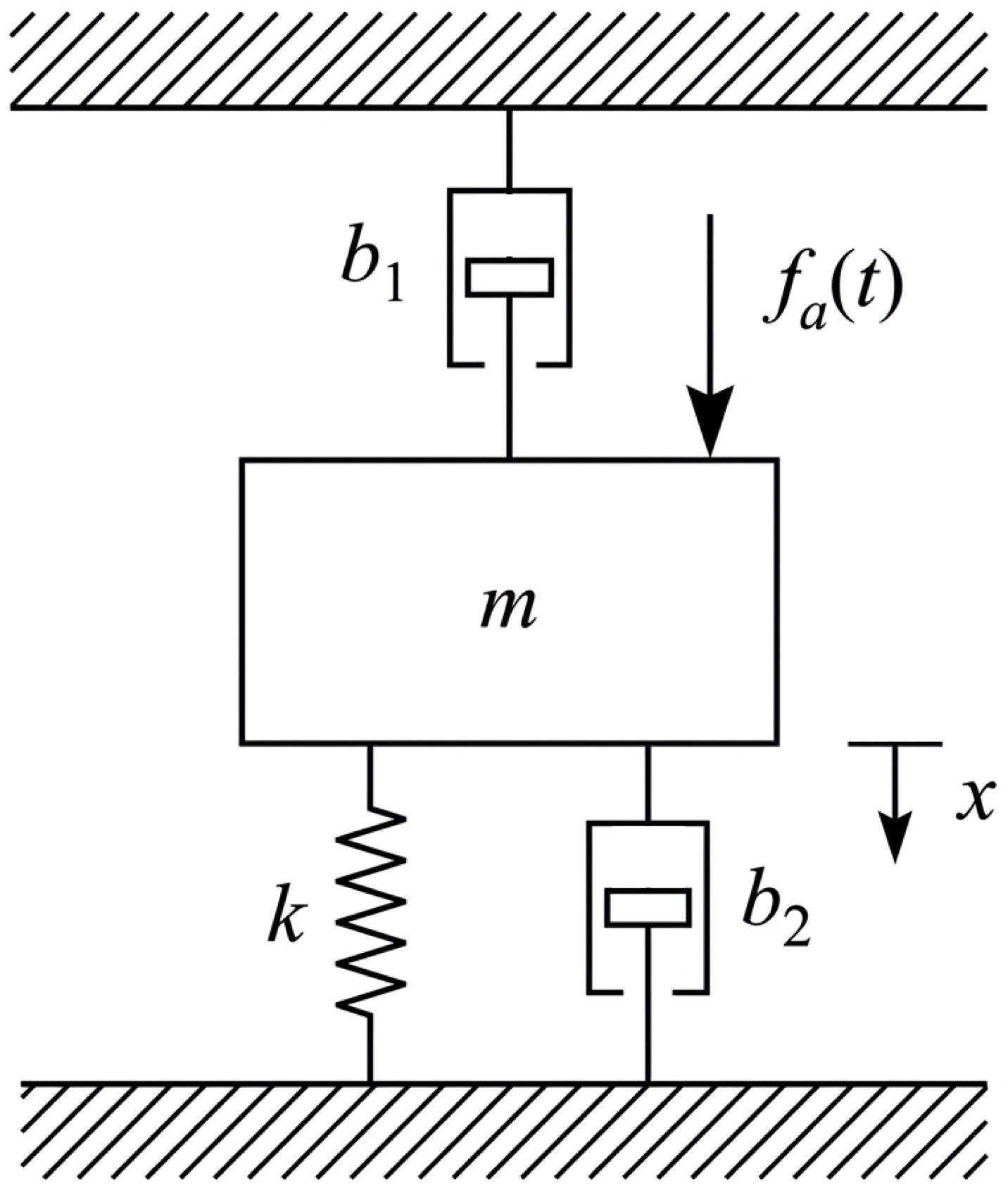
Consider the system shown below. Assume kg, N/m, N-s/m, and N-s/m.
a. Calculate the output of the system if the input is N.
b. Calculate which input frequency, , will cause the largest amplitude of mass displacement.