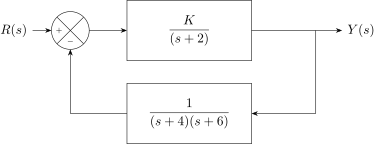
Homework 7
- Due Apr 21, 2026 before class begins.
Problem 1
A first-order system, , which has a time constant of sec is added to a closed-loop control system. Assume and in the control system. What is the new time constant that results from incorporating into a closed-loop system? (Hint: use the Lesson 15 summary posted under Lesson 16).
Problem 2
Create a Simulink file with two closed-loop feedback control systems: one with a PID controller and one with just a P controller. (Use the Simulink file from Lesson 15 as a starting point). Use a Repeating Sequence source for your disturbance with Time values equal to [0 1] and Output values equal to [0 2]. This type of disturbance is a ramp input and might be a leak that grows more severe over time.
Use a Sine Wave block (not Sine Wave Function) as R(s) and set its Amplitude = 1 and Frequency equal to “pi”. Set . Use the following model parameters for :
- cmH2O sec/L
- L/cmH2O
- cmH2O sec2/L
On the model with the PID controller, use , , and . On the model with the P controller, use .
Connect to the output plot as well so that it will be plotted on the same graph as the output of your system. Run the models. Show plots for both systems. How does the performance of the system with a P controller compare to the system with a PID controller? What happens if you set in each?
Problem 3
Given a unity feedback system with , find the steady-state errors for unit step, ramp, and parabolic inputs.
Problem 4
Imagine a feedback control system with a disturbance. Find the total steady-state error if
and
and and
Problem 5
Given a feedback system with , no disturbance, and unity feedback (), find so that the steady-state error is for a ramp input of .
Problem 6
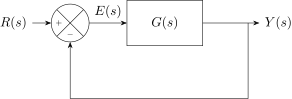
Determine whether the unity feedback system shown below is stable if
Problem 7
For the system shown below, find the gain margin if
a.
b.
c.